
Recently Sraddhalu Ranade of the Sri Aurobindo Ashram was prevented from engaging in open dialogue and debate with members of Auroville: LINK
Not all exact details are available but a reasonably accurate picture of the basic story can be constructed using available facts. A group in Auroville invited Sraddhalu to speak as per the following announcement:
An Open Talk by Sraddhalu
At SAWCHU on Friday 11th of May, 2012 – 5 to 7 pm
Sraddhalu will speak on the controversial book and its consequent events. A Q&A session will follow. This is a chance for all in Auroville to know of the controversy first-hand, and to clear the air of all the speculations and rumours.
All are welcome!
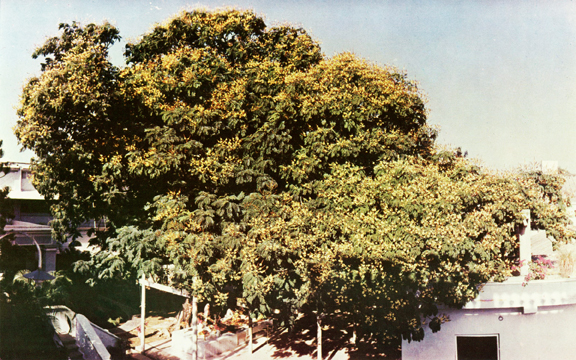
Fiftieth Anniversary of the Service Tree: May 1980
The tree was planted on a Tuesday in May 1930.
For worship lifts the worshipper’s bowed strength
Close to the god’s pride and bliss his soul adores…
To him who serves with a free equal heart
Obedience is his princely training’s school,
His nobility’s coronet and privilege,
His faith is a high nature’s idiom,
His service a spiritual sovereignty…
An offering to the self of the great world.

The above image is from a site (link) operated by a handful of Western chauvinists associated with the Sri Aurobindo Ashram, including one Aurofilio Schiavina and Richard Hartz, both posting anonymously. In this particular post they demean Sri Krishna, labeling him “a native taxi-driver” (click on the image to enlarge it and see the underlined label and tags at the bottom). Another Westerner complicit in this act of cultural defacement is one Paulette from Auroville who, in comments on the same post, tries to stigmatize critics of Peter Heehs with the taint of caste discrimination, the last resort of any self-superior Westerner out to shame an Indian/Hindu or a “native” (as they have referred to Sri Krishna here) into silence. Peeved at repeated reminders of Peter Heehs’ background as a New York cabbie these handful of bad apples have chosen to make a shameless display of their uncouth and arrogant boorishness in an attempt to fan the flames of divisiveness and racial prejudices.
From The Mother's "Prayers and Meditations"
September 5, 1914
“Face the danger!” Thou saidst to me, “why dost thou wish to turn away thy gaze or flee far away from action, flee from the battle, into the deep contemplation of Truth? It is its integral manifestation which must be realised, its victory over all the obstacles of blind ignorance and dark hostility. Look the danger straight in the face and it will vanish before the Power.”
The blow you wince at seems to you so hard because it is a blow the world of your mental formation has sustained. Such a world often becomes a part of our being. The result is that a blow dealt to it gives almost physical pain. The great compensation is that it makes you live more and more in the real world in contradistinction to the world of your imagination which is what you would like the real world to be. But the real world is not all that could be desired, you know, and that is why it has to be acted upon and transformed by the Divine Consciousness. But for that, knowledge of the reality, however unpalatable, is almost the first requisite. This knowledge often enough is best brought home to us through blows and bleedings.
It’s the same idea, that opposition and opposites stimulate progress. Because to say that without Cruelty, Love would be tepid … The principle of Love, as it is beyond the Manifest and the Nonmanifest, has nothing to do with either tepidness or cruelty. But Sri Aurobindo’s idea, it seems, is that opposites are the most effective and rapid way to knead Matter so that it may intensify its manifestation.
Wherever I be, in Paris, Pamplona or Prague,
My awareness moves about with the Emperor of Trees,
Overweighed, ever-green in shadowy Aprilling leaves
Sheltering the timeless sleep of a Godly love.
“The wives of Buddha and Ramakrishna felt proud when they were deserted.”
Then what’s the harm?
“If married life is an obstacle to spirituality, then they might as well not marry.”
No doubt. But then when they marry, there is not an omniscient ass like this biographer to tell them that they were going to be dharmaguru or dharma pagal or in any way concerned with any other dharma than the biographer’s.
Read more…
You think one acts against others only when they have done some harm? Usually it is just the contrary. Can you tell me why the strong use their strength against the weak? It is not that the weak have harmed them, but simply because they have the strength and wish to use it for their own ends and want to compel the weak to obey their force, so they beat them; when they have a chance, they ill-treat them. It is not because the weak have made mistakes; it is because they want to use their strength for their own purposes, for the satisfaction of their desires.


 Mirror of Tomorrow