
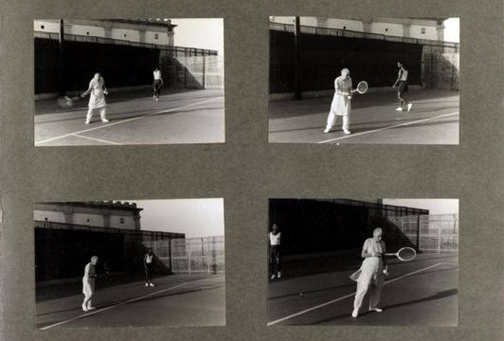
In Henri Cartier-Bresson’s life that remained eventful till the end, one chapter belonged to the photographer’s visit to Aurobindo Ashram in Pondicherry in the ’50s. The father of modern photojournalism had of course been to India earlier, met Mahatma Gandhi and even covered his funeral. All of that remains well-known but his work on the Ashram remains comparatively less talked about. Bresson, it is said, had a knack for bearing witness to historic moments. So this time too, he was there shooting Sri Aurobindo, the revered yogi-philosopher-guru-poet, just a few months before his death.
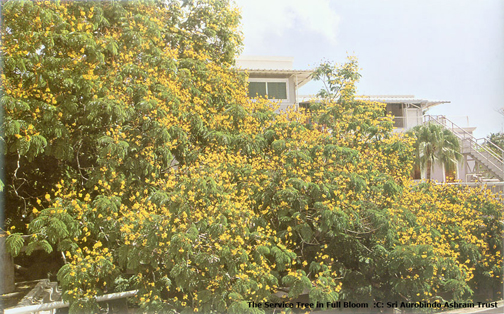
Service Tree in Full Bloom
Mother, suffering comes from ignorance and pain, but what is the nature of the suffering and pain the Divine Mother feels for her children—the Divine Mother in Savitri?
It is because she participates in their nature. She has descended upon earth to participate in their nature. Because if she did not participate in their nature, she could not lead them farther. If she remained in her supreme consciousness where there is no suffering, in her supreme knowledge and consciousness, she could not have any contact with human beings. And it is for this that she is obliged to take on the human consciousness and form, it is to be able to enter into contact with them. Only, she does not forget: she has adopted their consciousness but she remains in relation with her own real, supreme consciousness. And thus, by joining the two, she can make those who are in that other consciousness progress. But if she did not adopt their consciousness, if she did not suffer with their sorrow, she could not help them. Hers is not a suffering of ignorance: it is a suffering through identity. It is because she has accepted to have the same vibrations as they, in order to be able to enter into contact with them and pull them out of the state they are in. If she did not enter into contact with them, she would not be felt at all or no one could bear her radiance…. This has been said in all kinds of forms, in all kinds of religions, and they have spoken very often of the divine Sacrifice, but from a certain point of view it is true. It is a voluntary sacrifice, but it is true: giving up a state of perfect consciousness, perfect bliss, perfect power in order to accept the state of ignorance of the outer world so as to pull it out of that ignorance. If this state were not accepted, there would be no contact with it. No relation would be possible. And this is the reason of the incarnations. Otherwise, there would be no necessity. If the divine consciousness and divine force could work directly from the place or state of their perfection, if they could work directly on matter and transform it, there would be no need to take a body like man’s. It would have been enough to act from the world of Truth with the perfect consciousness and upon consciousness. In fact that acts perhaps but so slowly that when there is this effort to make the world progress, make it go forward more rapidly, well, it is necessary to take on human nature. By taking the human body, one is obliged to take on human nature, partially. Only, instead of losing one’s consciousness and losing contact with the Truth, one keeps this consciousness and this Truth, and it is by joining the two that one can create exactly this kind of alchemy of transformation. But if one did not touch matter, one could do nothing for it.
The English language features an anthropomorphic collection of nouns for the various groups of animals. We call a bunch of cows a “herd.” We call a group of geese a “gaggle.” We call a bunch of fish a “school.” We call a group of sheep a “flock.”
However, less widely known is a “pride” of lions, a “murder” of crows, an “exaltation” of doves and, because they look so wise, a “parliament” of owls.
Finally, let’s consider a group of baboons. They are the loudest, most dangerous, most obnoxious, most viciously aggressive and least intelligent of all primates. What is the proper collective noun for a group of baboons? Answer: a congress!
Now you understand why our country continues its descent into the abyss of a failing civilization.
Early in the 20th Century, in India, Sri Aurobindo had major experiences that crystallized in a new vision for humanity; at about the same time, the Mother, then living in Paris, had the same vision. They both foresaw, unknown to each other, the dawn of a new consciousness of Oneness unifying man with the entire existence, and changing him into a nobler and higher being, endowed with more knowledge and self-mastery, and thus gradually transforming earthly life to a “Life Divine”. Sri Aurobindo and the Mother met in 1911, and, over more than thirty years, worked together to realize this consciousness and to bring it down to the earth.
Today, early in the 01st Century, Sri Aurobindo and the Mother are considered by thousands all over the world to be among the greatest spiritual figures in the history of mankind by; the numbers of those deriving guidance from their teachings steadily on the rise, their works translated into most of the major world languages; and witness books, dissertations, radio stations, songs and videos dedicated to them; and many communities around the globe, most notably among them, the budding international city of Auroville0 in South India, being modeled on their philosophy and teachings. For all these reasons and many more, the translator finds it is time Sri Aurobindo and the Mother should enter the sphere of awareness of the Arabic reader.
Peter Heehs, the American author of The Lives of Sri Aurobindo (Columbia University Press 2008), has been an archivist at the Aurobindo Ashram in Pondicherry for over 40 years. However, long familiarity with his subject and with India has not translated into insight or even understanding. His 496-page tome seems to have been written by some racist koi-hai from the colonial era.
The “genre of hagiography … is very much alive in India” Heehs writes. “Any saint with a following is the subject of one or more books that tell the inspiring story of his or her birth, growth, mission, and passage to the eternal. Biographers of literary and political figures do not differ much from the model. People take to the received version of their heroes’ lives very seriously. A statement about a politician or poet that rubs people the wrong way will be turned into a political or legal issue or probably cause a riot. The problem is not whether the disputed statement is true, but whether anyone has the right to question an account that flatters a group identity.”
Obviously written for foreigners who know little of India (the people at Columbia University Press?), those lines are absurd. How many “riots” can we Indians remember that were sparked by a comment in a book about some poet or politician? How many law suits? The overkill continues in a comparison Heehs offers between two photographs of Aurobindo, one retouched to erase wrinkles and make him fairer. Such retouching is a common free service provided unasked by Indian darkroom assistants and their modern computerized counterparts; but Heehs sees it as devious hagiography, intended to make Aurobindo look more saintly. Upon that overblown conclusion he hangs the following startling declaration:
“Hagiographers deal with documents the way that retouchers deal with photographs. Biographers must take their documents as they find them. They have to examine all sorts of materials, paying as much attention to the subject’s enemies as by his friends (sic), not giving special treatment even to the subject’s own version of events.” There is no mention of the biographer’s responsibility to try and arrive at the truth, an omission we could consider an oversight if the book were not such a study in dishonesty.
He,—but who is he? The mental being in his mentality.
Who is it that feels himself to be separate from the world or things in the universe to be outside his being? Not the Spirit, for the Spirit contains the universe, creates and combines all relations. All personalities act in the one spirit, as our own multiple personalities act in one being. Spiritual being is their continent, they are not its constituents, but its outer results and the diverse representative selves of its consciousness and action.
Not, either, the supramental being. For the supramental being is one with the spirit in its original or basic consciousness, in its idea-consciousness it is ideally comprehensive of cosmic things or, if we must speak in terms of space, commensurate with the universe. The supramental being with one action of his Idea-self can regard universal being as his object of will and knowledge. That attitude is the seed of mind. It can regard it as contained in itself and itself contained in it, and in that way know and govern it. But it can too, like Spirit in its real action know all things by identity and govern all things by identity. Externality of being does not enter into supramental experience.
Supermind can see mind externalising objects; it can itself take a particular viewpoint fronting objects but it is in itself that it fronts them, as we front our subjective operations in mind. It does not regard them as something outside its own being, as we regard physically objects.
Mind is a delegation from supermind, which primarily regards existence as an object fronting its vision. Mental being also need not regard the universe as quite separate from or outside its own being. Subliminal mentality is capable by extension of a comprehensive relation with cosmic things and of entering into unity with the universe. Mind’s starting-point is not a containing universal vision or a knowledge by identity, but an individualised viewpoint from which it sees the universe. Still mind can arrive at a sort of containing vision, a mentalised cosmic consciousness.
Aurobindo never cared for money. When I was at Baroda, he was getting a pretty fat salary. He was alone, he knew no luxury, nor the least extravagance. But at the end of every month he had not a shot in the locker. …
While talking, Aurobindo used to laugh heartily. … He was not in the habit of prinking himself up. I never saw him change his ordinary clothes even while going to the king’s court. Expensive shoes, shirts, ties, collars, flannel, linen, different types of coats, hats and caps—he had none of these. I never saw him use a hat. …
Like his dress, his bed was also very ordinary and simple. The iron bedstead he used was such that even a petty clerk would have disdained to sleep on it. He was not used to thick and soft bedding. Baroda being near a desert, both summer and winter are severe there; but even in the cold of January, I never saw him use a quilt—a cheap,
ordinary rug did duty for it. As long as I lived with him, he appeared to me as nothing but a self-denying sannyasi (recluse), austere in self-discipline and acutely sensitive to the suffering of others. Acquisition of knowledge seemed to be the sole mission of his life. And for the fulfilment of that mission, he practised rigorous self-culture even in the midst of the din and bustle of an active worldly life. …
Then we discussed Indian culture, its present crisis, even the Hindu Code. When I said, “the younger generation is fed on theories and beliefs which are undermining the higher life of India,” Sri Aurobindo replied: “You must overcome this lack of faith. Rest assured that our culture cannot be undermined. This is only a passing phase.”
Then he sprang a surprise on me: “When do you expect India to be united?” he asked.
I was taken aback. I explained to him how our leaders had agreed to partition. “So long as the present generation of politicians is concerned, I cannot think of any time when the two countries—India and Pakistan—can be united.”
The Master smiled, “India will be re-united. I see it clearly.” Was it an opinion? Or a prophecy? Or was it clear perception?
I shook my head in doubt and asked how India could be re-united. In two short sentences he described what Pakistan stood for and indicated how the two countries could come together.
This second fast of Mahatma Gandhi of three weeks has disquieted me a little. There seems to be no way out, for Gandhi asserts that he can break his irrevocable fast only if he is persuaded that the inner voice which enjoins the fast on him is the voice not of God but of the Devil. I wonder whose voice it is though? Can it be anything but disastrous augury?
I don’t think it was the voice of God that raged and thundered till Gandhi decided to starve himself on to the danger line—it looks as if it were the other fellow. One can only hope that he will scrape through somehow and that the doctors are wrong as they most often are when they opine in the plural; but the last experiment was not encouraging. And as this time there seems to be no reason whatever for this inspired procedure and no practical or practicable object set before it, there is no tangible means either of bringing it to a timely close. What an extraordinary ignorance of spiritual things to take any “inner” shout for the command of the Supreme!
Read more…


 Mirror of Tomorrow